The Chleuh wedding:
traditions and stages of a Souss marriage
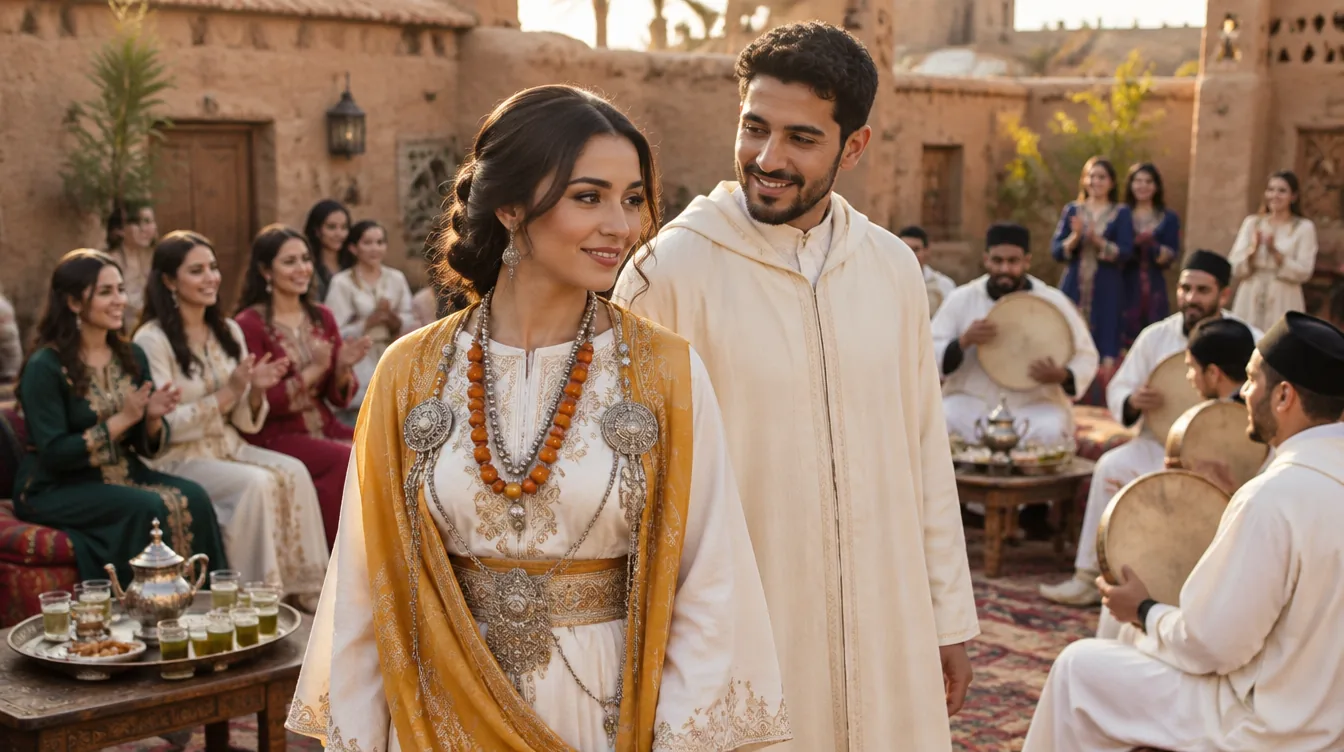
In the Souss, people do not say “wedding” but tamghra: the celebration. And the two words that carry it, isli and tislit, the groom and the bride, echo in every Chleuh family, from Agadir to Tiznit, from Taroudant to the Anti-Atlas. The Chleuh wedding shares most Moroccan traditions but keeps its own colour: silver rather than gold, ahwach rather than an orchestra, the whole village rather than just the family. Here is what makes it unique, how it unfolds and how to live it when you grew up far from the Souss.
A Chleuh wedding (Amazigh of the Souss) follows the main stages of a Moroccan wedding: proposal between families, religious act, henna and celebration. What sets it apart: the Tachelhit language, silver jewellery and fibulae, draped outfits, the music of the rways and the collective ahwach dance, and a celebration traditionally spread over several days. In the diaspora, most families keep the spirit of it while adapting: the civil marriage first, then an evening combining henna, Souss outfits and Amazigh music.
What makes the Chleuh wedding unique?
A Chleuh wedding is not another kind of wedding: it is a Moroccan, Muslim wedding, with the same proposal, the same religious act and the same sense of family. Its distinctiveness comes from the Amazigh culture of the Souss, passed down from generation to generation.
- The language: exchanges between families, songs and blessings are in Tachelhit.
- Silver rather than gold: traditional Souss jewellery is silver, with fibulae, necklaces and worked bracelets. The Tiznit region is renowned for this craft.
- The collective celebration: in villages, the wedding involves the whole community, which sings, dances and helps with the organisation.
- The music: the rways, poet-musicians of the Souss, and the ahwach, group singing and dancing to the beat of frame drums.
This identity still matters in the diaspora. Among DAR TISLIT's applicants in France, Agadir is the most frequently cited city of origin, among women and men alike, according to the analysis of applications received in France.
Looking for a serious person who shares your values? DAR TISLIT will open soon in your country.
Join the waiting list →The stages of a Chleuh wedding, from proposal to celebration
The sequence varies by village, family and era, but almost always follows the same thread. For the stages common to all Moroccan weddings (khotba, fatiha, sadaq, civil marriage), see our guide to the stages of a traditional Moroccan wedding.
1. The proposal between families
The young man's family visits the young woman's with gifts: sugar, tea, sometimes henna and fabrics. There is little talk about the couple and much about the families: where they come from, who they know, what values they share. In the Souss, the opinion of the elders still weighs heavily.
2. Agreement and the religious act
Once agreement is given, the terms of the marriage, including the sadaq (dowry), are set between the families, then the marriage is sealed religiously. In the country where you live, the civil marriage must be conducted according to local rules: check before setting dates.
3. Gifts and preparations
The groom's family brings its gifts to the bride: fabrics, jewellery, henna, traditional beauty products. The women of both families prepare the celebration weeks ahead. To see who covers what, read who pays for what at a Moroccan wedding.
4. The henna
The evening before the celebration, the women gather around the tislit for the henna night, with songs in Tachelhit, ululations and blessings. It is an intimate moment, often the most moving for the bride and her mother.
5. The tamghra, the celebration
In villages, the celebration traditionally stretched over several days. Meals are shared (tagines, couscous and amlou, that paste of almonds, argan oil and honey typical of the Souss), the bride is welcomed at her husband's home and people dance late into the night.
Outfits, jewellery and music: the traditions of the Souss
The bride's outfits
The traditional outfit of the Souss tislit is often a drape of light-coloured fabric, held at the shoulders by silver fibulae, with a belt and cascading jewellery. Today most brides alternate this Amazigh outfit with kaftans as the evening goes on.
Silver, the signature of the Souss
Fibulae, necklaces combining silver, amber and coral, bracelets and diadems: this jewellery is not just ornament. It is often passed from mother to daughter, and wearing one's grandmother's on the wedding day remains a powerful gesture for many families.
The ahwach and the rways
The ahwach is the soul of the Chleuh celebration: men and women, in rows or in a circle, sing and dance together to the beat of frame drums. The rways, with their rebab and poetry in Tachelhit, are the other great names in Souss music. In the diaspora, many families bring in an Amazigh group for at least part of the evening.
A Chleuh wedding is not watched, it is lived: you sing, dance and bless together.
Be among the first to know when DAR TISLIT opens in your country.
Notify me when it opens →Celebrating a Chleuh wedding far from the Souss
Organising a tamghra far from the Souss means making choices. The families DAR TISLIT supports often raise them from the first meeting:
- One celebration or two? Some families celebrate locally for relatives in the diaspora, then in the village for the family who stayed in Morocco.
- How many days? In the diaspora, several days of celebration often become a henna night and one big wedding evening.
- Which language? When only one spouse is Chleuh, Tachelhit, Darija and English are often mixed, in songs and speeches alike.
- The paperwork: civil marriage, birth certificates, registration with the Moroccan consulate… If in doubt, check with the authorities in your country and the consulate.
Language is precisely a question that keeps coming up. According to the analysis of applications received by DAR TISLIT in France, 28.7% of female applicants (of 680 responses) and 35.7% of male applicants (of 171) say they speak Chleuh fluently. In other words, many Chleuh families live their traditions without everyone speaking Tachelhit day to day: we look at this in do you need to speak Chleuh to marry a Chleuh?
Finding a Chleuh partner who shares these traditions
Wanting a Chleuh wedding often means hoping for a spouse who knows its meaning. But expectations are more open than people think. Asked whether they want a partner of Chleuh origin, 79.3% of female applicants say they are open to all Moroccans, 15.3% prefer a Chleuh and 4.4% want only a Chleuh (680 responses).
Asked freely whether they have a preference for a region of origin, 17.3% of female applicants (548 responses) and 21.2% of male applicants (193) mention the Souss, Agadir, the Chleuh or the Amazigh. Men therefore care slightly more often than women.
What we see in interviews: more than origin on paper, what gives a couple strength is shared values. Someone who respects family, faith and traditions will know how to take part in a tamghra, even if they do not yet speak Tachelhit. To go further, read our guide to meeting a serious Chleuh partner.
DAR TISLIT is for people of Moroccan origin who want to marry. The service is offered in France; a waitlist is open for the UK, the US and Canada.
A human, discreet and marriage-oriented approach: coming soon near you.
Join the waiting list →