Do you need to speak Chleuh
to marry a Chleuh?
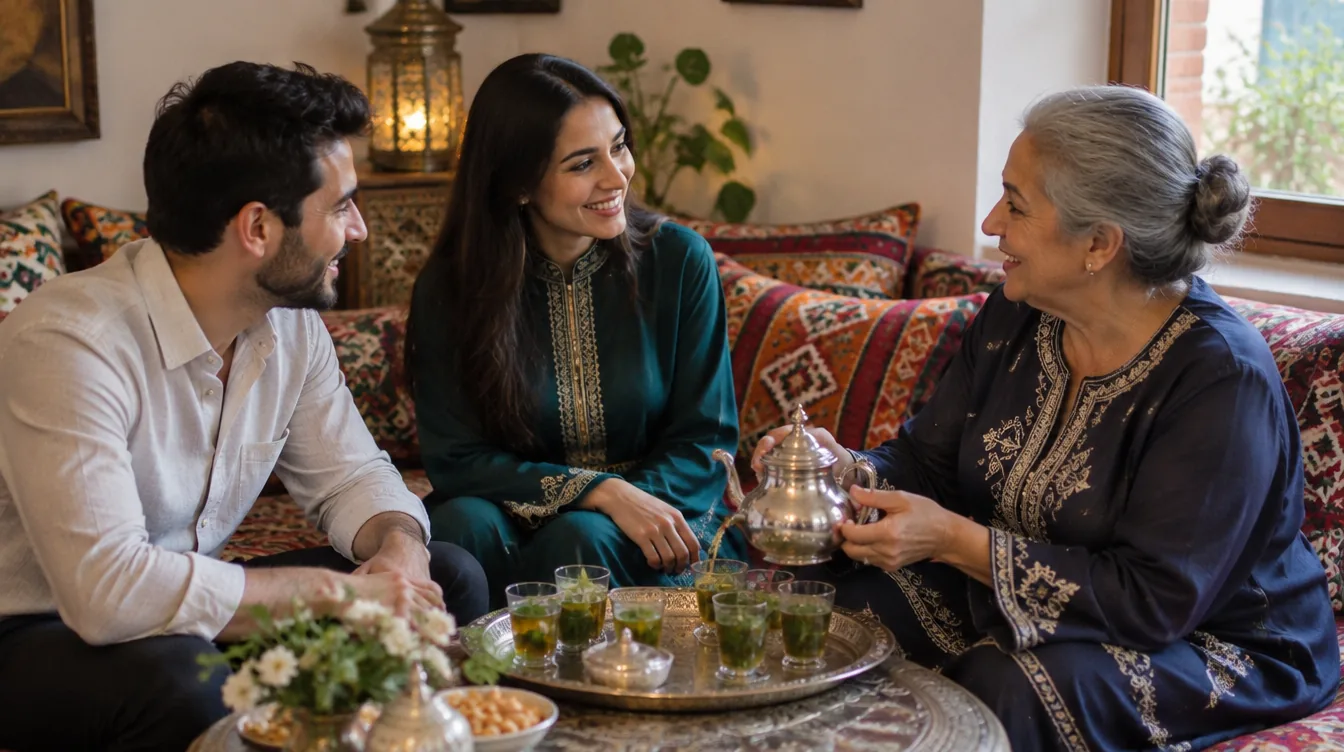
“I don't speak Chleuh, will his family accept me?” The question comes up often among singles of Moroccan origin considering marrying a man or woman from the Souss. It is a fair one: Tachelhit is a language of the heart, that of grandparents, celebrations and memories of the village. But what really happens in couples today? We looked at the figures from applications DAR TISLIT received in France.
No, speaking Chleuh is not a condition for marrying a Chleuh. According to the analysis of applications received by DAR TISLIT in France, 56.8% of female applicants and 45.6% of male applicants do not speak Tachelhit, and only 4.4% of female applicants want a Chleuh partner exclusively. The language remains a real plus with families, but values, respect and the seriousness of the commitment make the difference.
How many singles really speak Chleuh?
At DAR TISLIT, every application goes through a detailed questionnaire and then a human conversation. One of the questions is: “Do you speak Chleuh (Tachelhit)?” Across more than 1,200 profiles studied in France, the answers paint a picture many do not suspect: most singles of Moroccan origin do not speak Tachelhit fluently, including those with roots in the Souss.
In detail, of 680 women's applications, 28.7% speak Chleuh fluently, 13.5% a little and 56.8% not at all. Among men (171 responses), 35.7% speak it fluently, 18.1% a little and 45.6% not at all. In other words, not speaking Tachelhit is nothing exceptional: it is in fact the most common situation.
Darija, Moroccan Arabic, is by contrast widely shared: 65.9% of female applicants (534 responses) and 57.9% of male applicants (171) say they speak it fluently. In many couples, it is Darija, alongside the language of the country, that serves as the common language day to day.
Looking for a serious person who shares your values? DAR TISLIT will open soon in your country.
Join the waiting list →Chleuh only, or open to Moroccans? What female applicants say
People sometimes imagine Chleuh women only consider a Chleuh husband. The answers show the opposite. Asked “Do you want a partner of Chleuh origin only, or are you open?”, 79.3% of female applicants say they are open to Moroccans, 15.3% prefer a Chleuh partner without making it a condition and only 4.4% want a Chleuh partner exclusively (680 responses).
Asked freely whether they have a preference for a region or city of origin in Morocco, 38.3% of female applicants (548 responses) clearly say they have none and 17.3% mention the Chleuh, the Souss or a city such as Agadir or Tiznit. Among men, 21.2% mention a Chleuh or Souss origin (193 responses). A preference exists, then, but it remains a minority, and it concerns a shared culture far more often than command of the language.
These figures match what we see in interviews: what singles look for first are shared values, compatible religious practice and a genuine intention to marry.
Does language really matter to the Chleuh family?
While the future spouse often does not make it a condition, the question arises more on the side of parents and grandparents. In a Chleuh family, Tachelhit is often the language of the elders, the one in which people welcome, bless and joke. A son-in-law or daughter-in-law who does not speak it may feel, at first, slightly left out at family meals or celebrations.
But what families look at above all is attitude: respect for the parents, the place given to family, the seriousness of the commitment, the way of introducing oneself on the first visit. A man or woman who does not speak Chleuh but shows curiosity for the culture of the Souss, learns a few polite phrases and joins in the traditions often wins the family's heart much faster than you would think.
A Chleuh family does not ask for a language exam: it wants to know whether its daughter, or son, will be respected and surrounded.
It also happens that a parent expresses a strong preference. In that case, it is better to talk about it early and frankly: it is one of the subjects DAR TISLIT raises from the first interview, to avoid misunderstandings once an introduction is under way.
Be among the first to know when DAR TISLIT opens in your country.
Notify me when it opens →Marrying a Chleuh without speaking Tachelhit: practical advice
Are you of Moroccan origin without speaking Chleuh, and the person you like comes from a family of the Souss? A few simple gestures make a real difference.
Before meeting the family
- Learn greetings and polite phrases in Tachelhit: a few words spoken sincerely touch parents and elders deeply.
- Find out about the family's traditions: region of origin, wedding customs, the place of elders. Our guide to Chleuh weddings and the traditions of the Souss is a good starting point.
- Ask your future spouse for advice on what matters most to their parents.
During the engagement and after the wedding
- Take part in family moments, even without understanding everything: presence and goodwill speak for themselves.
- Learn gradually, with your spouse, their family or online resources: many couples say the language comes naturally with time.
- Think about the children: deciding together whether you want to pass on Tachelhit, Darija or both is a lovely conversation to have before the wedding.
And if you are the Chleuh one and the person you love does not speak your language, your role is precious: you are the one who will bridge between them and your family.
Darija, Tachelhit, English: the reality of couples in the diaspora
In the diaspora, most couples of Moroccan origin live with several languages. The language of the country often dominates day to day, Darija creeps into family exchanges and Tachelhit keeps a strong emotional place in families from the Souss. This multilingualism is not an obstacle: it is a richness many want to pass on.
Real compatibility lies elsewhere: in the vision of home, religious practice, the relationship with both families, life plans. That is why, at DAR TISLIT, language is one criterion among others, which we take into account when it matters to you but which never closes the door on a good match. To go further, read our advice on meeting a serious Chleuh partner.
DAR TISLIT supports people of Moroccan origin, Chleuh or not, who want to marry seriously. The service is offered in France; a waitlist is open for the UK, the US and Canada.
A human, discreet and marriage-oriented approach: coming soon near you.
Join the waiting list →